Blog

  • Why do Bolts Break?

    Broken bolts causing downtime have long been the source of frustration.  Collectively, a broken bolt can cost hundreds of thousands of dollars between repairing the machine, scrapping parts, employee pay, and money lost on sales loss.  So why do bolts break?

    Using the wrong Bolt

    In some applications, the bolt may break because it is too long.  This can cause the bolt to snap in half.  Ensuring that your bolt is a secure fit can reduce the risk of bolt breakage.  

    It’s not tight enough

    The bolt may be loose as stated by Proven Productivity, fatigue failure, one of the causes is improper tightening of a bolt.

    Fractured bolts

    The bolt may be fractured which can be caused by extreme temperature changes or stress from movement of parts.  Thomas refers to this as “Bolt Locking” caused by large amounts of vibration which results in uneven stress on bolts can cause breakage.

    The threads become stripped

    The top of the bolt twists off, most often the result of tightening the bolt too tightly or using the improper tool for tightening the bolt.

    The top of the bolt breaks off

    As proven productivity states, bolt failure may happen as a result of fatigue failure.  This can be a result of not tightening the bolt properly causing stress and eventual failure.

    What can you do when a bolt breaks?

    Chances are if you have visited online forums or experienced broken bolts in a shop you know there are a lot of interesting tricks to removing broken, sheared off, stripped, and snapped bolts, screws, and other fasteners.

    Ideally, a tap buster will remove your broken tooling in no time.  However these machines are expensive and your company may not invest in a tap zapper if you are not breaking off bolts, drills, and taps on a regular basis.  You may be able to find a shop that offers broken bolt removal service and that investment is well worth your time considering most of these suggestions also take a majority of a day to remove.

    Penetrating fluids – this trick can help remove a broken fastener especially if you soak the part and wrap it to avoid evaporation.  This method is designed to crack the broken fastener at the last point of contact which may result in a bigger mess.

    Depending on your situation, you may be able to improvise using hand tools.  Sawing or filing may easily remove the fastener as on a larger hex bolt.  Specialty stud removal tools and left-hand drill bits are designed to remove these broken bolts but they may not be as effective as advertised.

    Are Metal Disintegrators EDM machines?

    It may not be common knowledge, the specialty tool developed just for removing broken bolts was developed in the early 1940s.  If you have heard of a tap zapper or spark eroder, these are slang terms for the metal disintegrator. This machine can remove broken bolts in minutes.  The technology basis for this machine is EDM which has evolved to include many subcategories over the years as this technology has improved.

  • Electro ARC’s New Tool for Metal Disintegrator owners

    As Electro Arc machine owners, we understand that you need resources in addition to the owner’s manual you received with your metal disintegrator.  As a company that has been producing metal disintegrating machines for 75 years, we know we have quite a few versions of our product in use with various stages of support needed.

    Since Stillion Industries purchased Electro Arc, we have been striving to improve both the product and the support offered for these machines.  Both of these processes are time-consuming and costly, so it has taken us a while to get to the point where we can produce new media to replace set-up and operation videos that are currently available.  We have been offering new content through our YouTube channel to address common questions and demonstrate how our machines work.

    We recently released a 30-page troubleshooting guide which addresses the most common issues machine owners may have with their metal disintegrator or disintegrating head.  This guide is free of charge and is available for download in our store here on ElectroArc.com   You may have noticed that a majority of the content from our troubleshooting section has moved.  This is because we have created a new resource to assist existing machine owners.

    We have also dedicated a new website to hosting all of the current setup and operation videos that we have for our metal disintegrators (yes, they are from the 90s) but they do cover the important points new machine owners may need to cover for training purposes.  This website Metal-disintegrators.com is dedicated to providing a resource for machine owners through multi-media.  We will continue to expand and improve the content available on this site.


    Add to cart


    Standard Starter Set


    Rated 0 out of 5(0)

    $532.50


  • Your Guide to EDM Terminology

    EDM has become a common method used across industries with a number of sub-categories including MDM.  This list of EDM terms can help you understand all of the aspects of EDM.  Many of these terms are interchangeable with MDM terms:

    Ammeter (Amp Meter) – A measuring instrument for electrical current.

    Amp (amperage) applied – Amperage selected on power supply controls.

    Amp (amperage) average – Amperage shown on the amp meter.

    Arc (Arcing) A damaging flow of electricity (pulsating yellow flash) between electrode and workpiece.
    Incorrect term for EDM machining (sparking).

    Average current – (see average amp)

    Blind Hole (cavity) – A cavity with no flush holes.

    Burning – A synonym for EDM Machining.

    Capacitor – An electrical component that stores a charge.  Used occasionally to intensify the spark.  (Wear on Electrodes will result).

    Carbon – The raw material used to make graphite.

    Center Flushing – Flush hole through the center of electrode..

    Conductor – A material which will carry electric current.

    Coolant – See dielectric.

    Copper Graphite – Graphite infiltrated with copper.

    Copper Tungsten – A blend of copper and tungsten.

    Core – A non-machined area of the cavity created by the flush hole(s) in the electrode.

    Corner Wear – Wear on the corners of the electrode parallel to the direction of machining, and proportional to the distance machined.


    Crater – Small cavities in the workpiece created by the individual sparks.

    Cut – Synonym for machining with the EDM process.

    DC Arcing – see arc.

    Deionization – Bringing the sparkgap back to a nonconductive state.
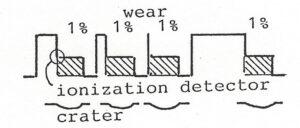
    Depth finder – An electronic circuit which automatically stops the electrode .0001″ before it touches the workpiece without the high voltage on.  Used during “setup” for setting an accurate depth.

    Dielectric – A fluid which insulates the sparkgap between the electrode and the workpiece until a high voltage ionizes the sparkgap and makes it a conductor.


    Dither – See vibrator

    Discharge – see spark

    Dual powersupply – Two identical power supplies in one single cabinet, used to inform the operator when the electrode makes contact with the workpiece, usually with light or an acoustic signal.

    Duty Cycle -“on time” +”off time”


    EDM Grinding – This procedure is accomplished by mounting a rotating electrode wheel parallel to the direction of the servo.

    Electrode – The “cutting tool” in the EDM process, always made of a conducting material.

    End Wear – The linear wear at the end of an electrode after EDM machining.

    Flashpoint – The temperature at which a flammable material will ignite.  An important factor in selecting a dielectric. 

    Filtering – Removing the solid particles created during the machining from dielectric.

    Flushing – The single most important Factor in EDM machining.

    Flush Hole – A hole to facilitate flushing through either the electrode or workpiece.

    Flush Pressure – The necessary pressure to insure an even flow over the “area of contact” between the electrode and the workpiece.

    Flush Tank – Also called flush plate or flush pot, a box-like fixture mounted on the worktable. The flush hose connects to the side of the box and the workpiece is clamped either directly or on a subplate, on top, allowing the workpiece and into the empty space of the box.

    Gap (spark gap)  – The distance between the electrode and the workpiece during machining.

    Gap Voltage – The average voltage in the sparkgap during machining. (meter reading).

    Frequency – The number of discharges (sparks) per second.

    Graphite – An easy machineable electrode material with high heat resistance and good electric current transfer.

    HAZ (heat affected zone) – Also called the “recast layer”.  The depth of the heat penetration altering the parent material’s metallurgical structure due to the EDM process.  Magnitude usually from .0002″ to .008″ depending on the material and the energy per pulse.

    Hunting – Excessive reciprocating movement of the servo during machining caused by shorts in the stopgap.

    Injection flushing – A synonym for pressure flushing.

    Ionization – A breakdown of the resistance in the dielectric flowing in the sparkgap, when a voltage of sufficient magnitude is applied between electrode and workpiece.

    Ionization Channel- The path of the positive and negative ions linking the electrode and the workpiece at the moment of ionization.

    Microsecond – One-millionth of a second (.000001 seconds) (usec).

    Multilead–One power supply with multiple independent power leads.

    Nanosecond – One billionth of a second (.000000001 seconds)

    Non-directional – A finish having no specific direction to its surface pattern.

    Normal Polarity – Negative polarity.  A designation no longer used, as the polarity depend on the application, and as such a polarity (positive or negative) can only be normal in relation to a given application.

    No Wear – No wear as such does not exist, but generally speaking, wear less than one percent is called “no wear”  range, a deposit or plating can occur so the electrode actually grows, but as this phenomenon is unpredictable it has no practical value.

    Oil through Chuck – A sealed adjustable chuck for tubular electrodes which allows a flow of dielectric fluid through the chuck to the electrode.

    “On Time” – Duration of the applied amperage during one pulse cycle measured in nanoseconds.

    “Off Time” – The time in microsets between the applications of open gap voltage.

    Overcut – The dimension the finished cavity is larger than the electrode. (2 x sparkgap).

    Redressing – Removing the worn part of an electrode, bringing it back to its original shape.

    Recast Layer – See HAZ.

    Reverse Polarity – see normal polarity.

    Servo – The electro-mechanical mechanism which automatically maintains the proper spark gap during machining.

    Spark -controlled discharge between electrode and workpiece.

    Sparkgap – The distance between the electrode and workpiece during machining.

    Spark Erosion – Synonym for EDM.  Mainly used outside the U.S.

    Split Lead – See Multi lead.

    Stepped Electrode – An Electrode constructed in two or more concentric tiers, to be used for through-hole machining,  The first smaller portion is used for the roughing, and the larger subsequent tiers are used for the medium to finishing machining.

    Trepanning Electrode -An electrode constructed like a cookie cutter.  Used to machine through holes, this way increases the machining speed by minimizing the amount of workpiece material to remove.
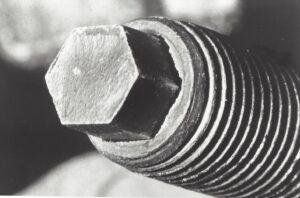
  • Comparing Electro Arc disintegrating heads

    Electro Arc’s Arc-er portable disintegrating head

    Arc-er Head in action

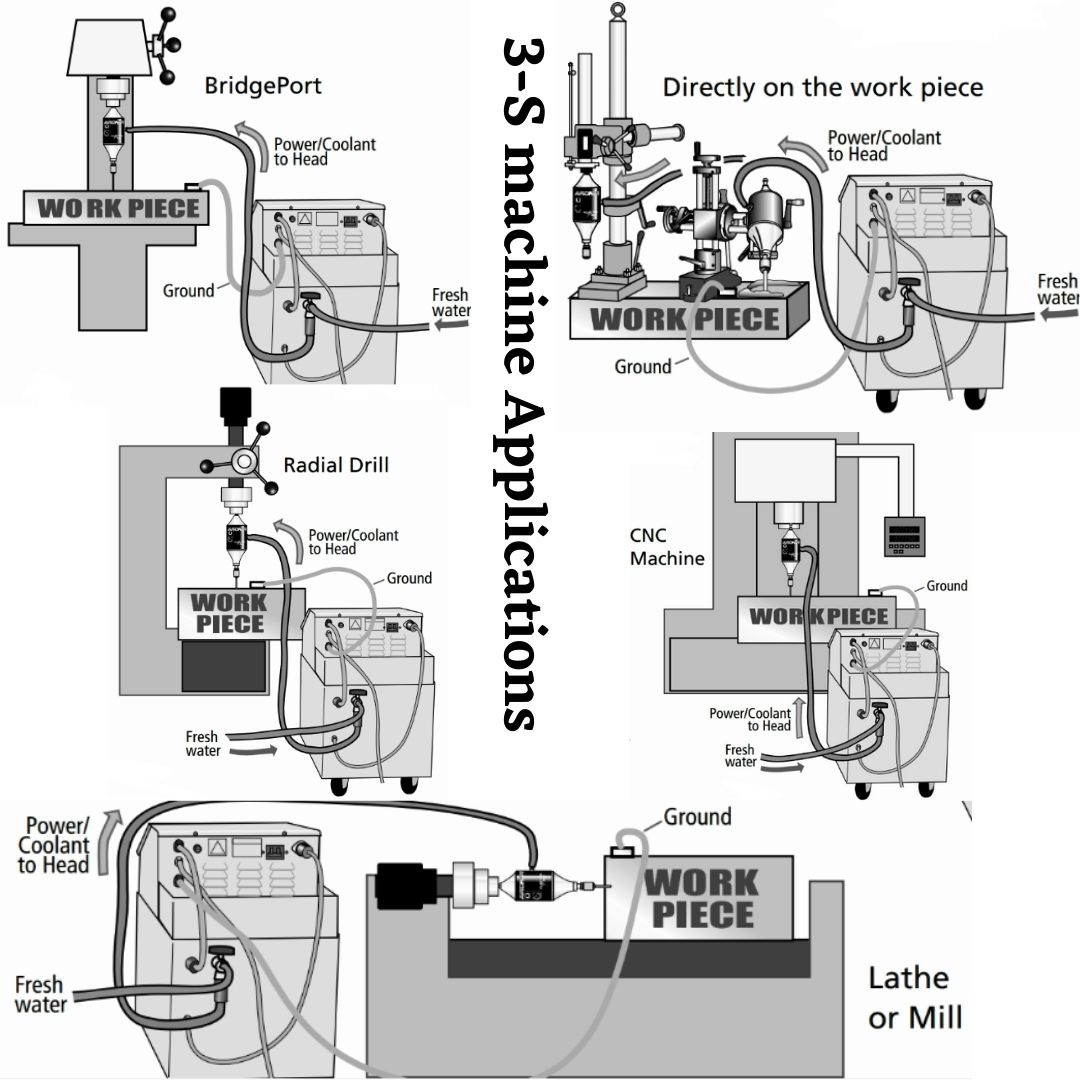
    The Arc-er head is ideal for portable use. You can use it with portable or tabletop metal disintegrators. You can also use the Arc-er head with machine tools like CNC machines, Bridgeport, Radial drill, lathe or mill, and directly on the workpiece. This head operates at any angle. You can remove broken tooling from .079 to 3/4 inches in a single pass.

    The Arc-er head is standard with the following machines:

    2-S
    2-SB
    2-SE
    2-SET
    2-SA
    3-S

    In September of 1998, the Arc-er head was introduced as an upgrade for the previous LBH head. Although similar in design and use, the Arc-er head features an LED current monitoring system to assist you in maintaining optimal use of your Arc-er head and saves on electrode consumption.

    You can also purchase the ultra-compact mini-mag 800 lb fixture or the portable magnetic base fixture which attaches to ferrous surfaces and provides 3000 lb holding power for use with your arc-er head. You can expect reliable heavy-duty service with your Arc-er Head which is designed to remove taps, drills, and studs up to 1″ diameter.

    Electro Arc’s IQ Precision Disintegrator Head

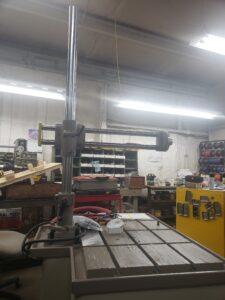
    IQ head on our test stand

    The IQ precision disintegrator head is a high-performance head engineered for heavy-duty use. You can use this head horizontally or vertically. Thermal protection prevents any potential damage from overheating. You can use the IQ head to remove taps, bolts, drills, and fasteners up to 1″ in a single pass.

    The IQ head is a standard feature for the following metal disintegrators:

    2-SQT

    2-DV

    2-DVQ

    2-DVT

    2-DVQT

    1-SV

    1-SVT

    1-SVQ

    1-SVQT

    HK-6V

    The IQ head body enables smooth movement with 9″ of manual or automatic travel. This head is ideal for small taps from 0-80 or extremely large taps such as 2-inch taps or larger bolts such as 1 1/4-inch bolts and up. If you need to disintegrate carbide, look at the Servo head below:

    Electro Arc’s Servo Disintegrator Head

    Servo Head test burn

    A high-performance disintegrating head, engineered for heavy-duty precision use. You can use this with electrodes from .020 inches to 1-inch diameter. You can use this machine to take out broken tooling including taps, bolts, drills, fasteners, etc. from 2# diameter in a single pass. Larger diameters are handled with multiple passes.

    The Servo DC disintegrator head is standard on all of our DC machines.

    We offer the full-size servo disintegrating head and a mini servo disintegrating head. The servo head is specially designed for heavy-duty use and comes standard with our most powerful machine, the Bolt Eater. This head disintegrates broken bolts 2 inches or larger. The mini servo DC disintegrator head is ideal for portable disintegration giving you ease of use at all angles and in small spaces.

    Not sure what disintegrating head is best for your application? Try out our Machine Builder!

  • Why Do I Need DC Cutting?

    D.C. cutting is direct current cutting, which is a naturally occurring process that moves metal from a positive pole (+) to a negative pole (-) when current flow is initiated (switched on) and subsequently interrupted (switched off). You may not know that this process is as old as the storage battery. It was also responsible for the problems of the early automobile ignition points and plugs – excessive wear on the positive terminals caused by the rapid switching of a D.C. circuit.

    D.C. cutting is the basis for all convention and wire EDM machine technology (not to mention Electro Arc Metal disintegrators) and predates the electric light bulb.

    DC Portable Metal Disintegrators Heavy-duty power for onsite or occasional use

    How Does DC Cutting Work?

    D.C. cutting or EDM cutting occurs when an ionized path is established (switched on) between a positive and negative pole and then broken (switched off) to stop the current flow. The simplest example is what occurs when the (+) and (-) poles of a car battery are momentarily (with jumper cables) touched together (switched on) and then pulled apart (switched off). When the cable clamps are examined you discover a crater on the positive clamp and an equal amount of material added to the (-) clamp – EDM in action!

    Harness this D.C process to remove broken taps, drills, and bolts quickly and easily. Minimum heat is generated and low power is consumed because polarity is the major moving physical property. High amperage, can waste power as a violent arc is created generating excessive heat and causing extreme electrode wear.

    How do Electrodes Work in the Metal Disintegration Process?

    Did you know that any conductive material can be used as an electrode? The more conductive the electrode material, the more effectively an electrical process works, and this is an electrical process.

    Electro Arc machines can be used with inexpensive copper tubing. Copper has superior conductivity (next to silver), low cost, and is easy to work with. It has the added benefit of being very conductive both electrically and thermally to aid in removing residual heat from the cutting area. We use other materials as electrodes for cutting operations where higher temperature arcs are required to remove high-temperature materials such as high-temperature bolts that are alloyed with molybdenum and other elements.

    You need D.C. cutting because you are constantly searching for a better, faster, cheaper way to get your job done. D.C. cutting gives it to you because it moves metal faster through polarity while minimizing heat and power consumption through lower amperage requirements that always accompany the use of polarity as the major moving physical property.

    How does D.C. cutting compare to A.C. cutting?

    A.C cutting is the creation of a violent arc between a high melting temperature (molybdenum/melts at 4748 degrees Farinheight and 2620 degrees Celcius) electrode material and a lower melting point material (tool/steel/melts at 2500 degrees Farinheight and 1371 degrees Celsius) and the fact that the lower melting point material (steel) will melt faster than the high-temperature material (molybdenum). You will want to use DC current with carbide because it cuts faster than AC, you may also need a DC machine if you are planning to use your metal disintegrator on larger bolts.

    Electro Arc’s AC metal disintegrators were the first metal disintegrators available on the market, released to the general public for purchase in 1947. While competitors came and went over the years, Electro Arc remained the best metal disintegrator manufacturer purchasing competing brands including Elox, AC machines are generally cheaper than DC machines and provide a larger variety of options for customization.

  • Electro Arc Celebrates 75 Years as a Michigan Manufacturer of Metal Disintegrators!

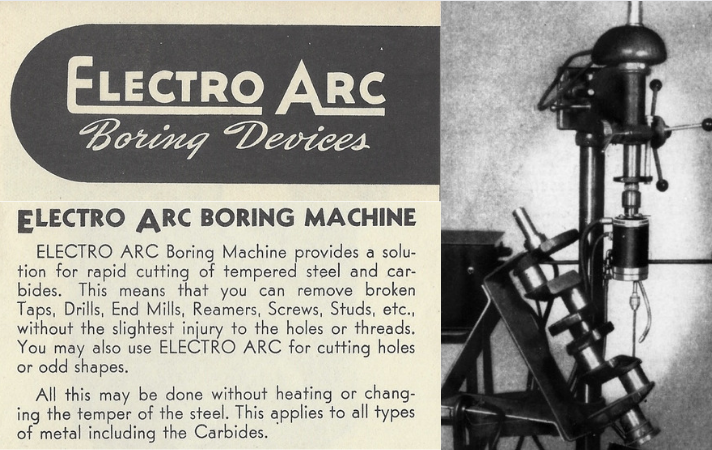
    Electro Arc was formed in Detroit Michigan on May 26, 1947, by Harold W. Stark, who was a metallurgist/manufacturer and investment broker.  Harold’s team patented the AC metal disintegrator in 1942.  The metal disintegrators were originally branded as “boring machines” while patents were pending:

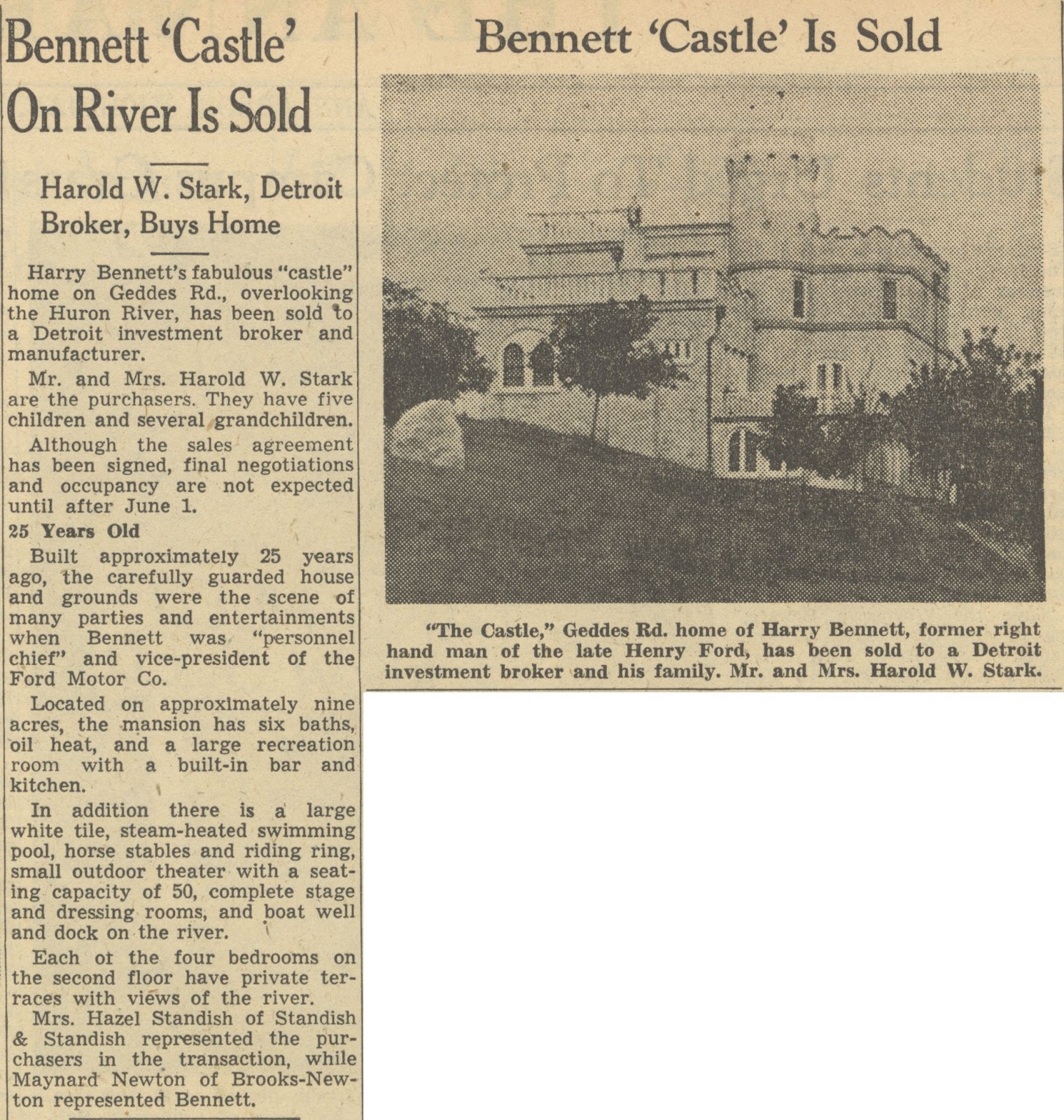
    In 1949 Electro Arc moved its operations to Ann Arbor, running the business on the island across from Stark’s new residence, “The Castle” on Geddes Road.  Nicknamed “The Castle”, this notable location was one of many properties associated with Ford’s close associate Harry Bennett. Stark purchased this unique property in a private sale offered by Bennett in 1948.  The castle and Electro Arc stayed in the family, with Harold Stark’s eldest son, Harold Stark II taking over the business in the 1960s after his father passed away and moving his own family into the castle. The castle was sold in the 1970s  but Electro Arc operations remained on the Island. Stark II moved the company operations to 161 Enterprise Drive in Ann Arbor, MI in 2008 in order to accommodate expanding operations.  The company remained at this address until the company was purchased by Stillion Industries.

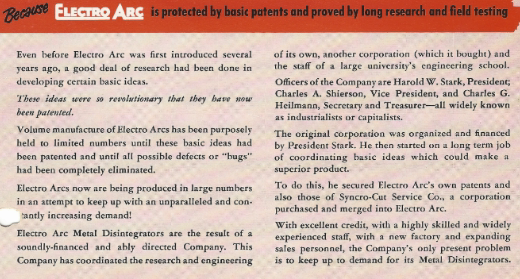
    New promotions rebranded these machines as “Electro Arcs” and later “metal disintegrators” as they are currently known and referenced pending patents as the reason for limiting prior promotion of the Electro Arc product line.  Electro Arc also merged with Syncro-cut Service Co, working closely with a large university’s engineering school as mentioned below:

    Electro Arc continued on to release several new products increasing its product line to over 40 bespoke machines.

    The F-5 Carbide Impregnator was introduced in mid-1964, this machine improves the life of drills, milling cutters, stamping and extrusion dies, lathe turning tools, slitting saws, form tools, taps, broaches, and punches by hardening wear surfaces of these tools.

    The Model 3-S  lightweight portable metal disintegrator was released in November 1964.  This machine was designed to remove taps of any size, drills as small as .040 diameter without distorting the hole, it cuts shapes of any shape in hardened steel without distortion.  We continue to manufacture and sell these machines.  This machine was updated in February of 1966 to include a coolant tank base.  Later the same year, the Model 1 metal disintegrator was released.

    In 1967 and 1968 Electro Arc released the 2-SE and 2-S portable disintegrator models.  The Model 2-S originally featured the LBH head which has since been upgraded to the arc-er head. This versatile disintegrating head can be chucked to any machining device at any angle (as shown above) and has a pull-out coolant tank designed for easy cleaning.  The 2-SE has the features of the 2-S with the addition of a 20” x 19” cast iron tabletop featuring 3 T-slots.  

    Between 1969 and 1972 Electro Arc introduced several of its HK machines beginning with the HK-6, which at the time was the largest and most versatile table metal disintegrator available.  This machine designed for extra heavy workpieces has a capacity of 8000 pounds, features a double-barrel 27-inch cross-arm which rotates 360 degrees and offers power feed which eliminates the possibility of human error.

    In 2004 When Electro Arc purchased long-time competitor Uni-Tek, the metal disintegrator line doubled, now offering both AC and DC machines.  DC models like the 2-SC and all of the DC tabletop models are perfect for disintegrating carbide.  The X-1 and X-2 Extract All machines are portable and ideal for use onsite.  The Bolt Eater provides heavy-duty cutting power with the servo head on a portable machine.

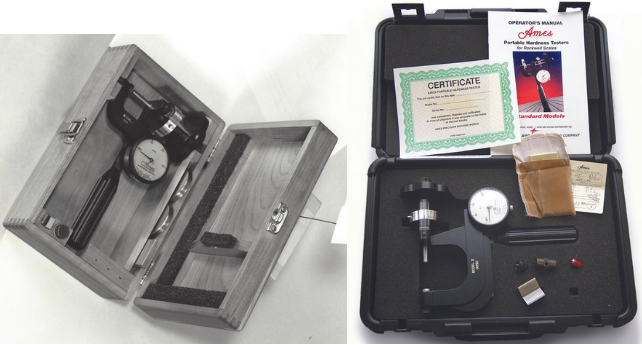
    In 1975 Electro Arc began producing the Ames Portable Hardness Tester Line, introducing the Model 8 portable hardness tester in 1975, the tube hardness testing model ST in 1977, and offering a digital tester briefly in the 90s before discontinuing it.  In 2000 the company upgraded from the wooden case for hardness testers to a high-impact case.

    Both Starks purchased many companies during their commitment to Electro Arc, including metal disintegration companies Elox, Vibra’Arc, Marbaix, Jiffy, and Unitek.  Ames joined the Electro Arc family in 1975, adding Ames Portable Hardness Testers to the Electro Arc product offerings. Stillion Industries is a family-owned machine shop which also began in Ann Arbor. Stillion Industries opened its doors to offer machining services in 1972.  Originally started by Chuck Stillion, and now run by his son Keith Stillion, who moved the company to Dexter in 2014 after purchasing Dexter Manufacturing. Stillion Industries machined parts for Electro Arc for years before Keith Stillion purchased Electro Arc in July of 2019. Now, 97% of the parts for each portable hardness tester and 50-65% of the parts for every metal disintegrator are manufactured on-site here in Dexter, Michigan.  We also continue to manufacture molybdenum electrodes, and other accessories for use with Electro Arc machines, offer repair and refurbishing services for Electro Arc and Uni-Tek machines, and provide calibration and repair services for the Ames Portable Hardness Testers in addition to selling Ames accessories including test blocks which are available for purchase on our website.

    At its peak, Electro Arc maintained 4 international offices.  Currently, Stillion Industries is our main headquarters with our United Kingdom office managing international sales for a number of countries not serviced by our home office.  As Stillion Industries celebrates 50 years of machine shop service in the community, we also celebrate 75 years of Electro Arc, a company that has maintained local manufacturing of all of our products for the life of the company and continues to offer innovative solutions across industries.  To commemorate this milestone for Electro Arc, we have created a timeline of the company’s milestones over the last 75 years available for you to explore.  We are also offering a limited number of Ames model 1 hardness testers in the original wood box for sale on our website. 

    Merging with Electro Arc has been a huge undertaking for Stillion Industries and we strive to improve the notoriety of these durable machines with hopes to donate an Electro Arc’s old machine to The Henry Ford Museum.  In the past, Ford had specially built metal disintegrators, and Ford Sr. was a friend of Harold Stark Sr.  What a wonderful way to celebrate the history of this company and our hopes for years to come!

  • What is the History of Electro Arc and EDM?

    When you search for the term “metal disintegrator” you will likely find ‘Electrical discharge machining’ as a result.  That is because the technological breakthrough that led to metal disintegrating machines was spearheaded by a team including Harold Stark who went on to patent the idea for AC metal disintegrators and started the world’s first metal disintegration machine factory in Detroit Michigan.  This process is metal disintegration machining (MDM).

    You may have heard Electrical discharge machining, EDM for short, called spark machining, arc machining, and spark eroding.  This is a non-conventional group of machining which now includes electrochemical machining, water jet cutting, and laser cutting.  This process is limited to use with ferrous alloys because it requires the base material to be electrically conductive.  A solution for high-accuracy, complex machining applications provides an efficient alternative where other methods are impossible.  Using an electrical current, spark discharge erodes the workpiece using dielectric fluid as an electrical insulator. There are three main forms of EDM, wire EDM, die sinker EDM, and hole popping EDM.  

    EDM is usually associated with the wire EDM machine method which was developed between the 1960s and 70s to make dies from hardened steel.  This EDM process uses wire wound between two spools of wire creating two electrodes, the tool-electrode, and workpiece-electrode, which are separated by dielectric fluid. With increased voltage, the fluid produces an electric arc. The wire moves in a controlled pattern and sparking occurs between the wire and the workpiece.  This method removes excess material with automated technology similar to CNC providing high accuracy and precision.  Commercial wire EDM capability has continued to advance substantially over the last few decades.

    Joseph Priestly originally discovered the erosive effect of electrical discharges in 1770.  Die sinker EDM was invented independently by two groups.  In 1943 two Russian scientists Boris and Natalya Lazarenko were exploring methods to increase the lifespan of tungsten breaker points. Their research led to the discovery that erosion could be precisely controlled if the electrodes were immersed in dielectric fluid. This allowed the invention of an EDM machine tool for processing hard materials like Tungsten. This tool became known as a resistor-capacitor (R-C) circuit for EDM.  

    During this time, without knowledge of the experimentation taking place in Russia, a team of American scientists consisting of Harold Stark (the founding president of Electro Arc), Victor Harding and Jack Beaver were also developing a method to remove broken drills and taps from aluminum castings.  This team was tasked by their employer with finding a solution because tools were being broken off in expensive aircraft parts.  Initially constructing machines from electric etching tools, they were unsuccessful.  After trying compressed air, they added fluid to the machines, combined with spark repetition allowing them to cut through metal quickly and efficiently while the coolant flushed away metal particles created in this process. Their research was able to produce 60 sparks per second, a breakthrough in technology at the time. Machines initially developed by this team were used during World war II and the trio patented the system for removing broken bolts, taps, and drills as well as an electronic-circuit servo system that maintained proper spacing between the electrode and the workpiece.

    This led Harold Stark to develop Electro Arc’s Metal Disintegrator line of metal disintegrating machines which are still produced by Stillion Industries today (Stillion Industries purchased Electro Arc in 2019).  This technology was key in the development of vacuum tube EDM machine tools capable of producing thousands of sparks per second (electric discharge machining) in the 1960s.  Die sinker EDM machines are traditionally used to create three-dimensional shapes.  EDM provides an advantage because the process is predictable and accurate, making it easy to reproduce, but it is slower than other methods.

    Hole drilling EDM is a specialized hole-making machine sometimes called a “hole popper” which is used to create the pilot hole necessary for wire threading. Using thermal energy rather than mechanical force, these machines cut through extremely hard materials such as titanium, carbide, carbon graphite, and high alloy steel.  These machines work on the same principle as wire EDM machines.  Instead of wire, these machines use a tool that works like a drill bit, no physical contact takes place between the tool and the workpiece, the electrical discharge is conducted to rapidly cut the metal.  This process is ideal for extremely small holes, as small as 0.010”. 

    In his book, ‘Electrical Discharge Machining’ Elman C. Jameson mentions working with Victor Harding and Harold Stark during the origination of the EDM process in the United States.  EDM became popular in Japan as a result of damage from the war.  This new method was key in rebuilding after the destruction of their infrastructure.  On the other hand, The existing equipment and workers in the US caused a delay in the acceptance of EDM technology in the US.  Electro Arc metal disintegrators are an appealing option because they do not require special training for operators as other EDM machines require.

  • 8 Recommendations for Electro Arc Machine and Operator Safety

    Your Electro arc Machine is durably built, thoroughly tested, and inspected at the factory. You can expect many years of service with minimal maintenance. To maintain the accuracy, dependability, and cutting speed built into your metal disintegrator, please heed these warnings and recommendations for machine and operator safety.

    Warnings: When connecting your machine to power – The Installer and Electrician must confirm that a solid ground exists between the cabinet and the building ground.

    NEVER CHANGE THE HEAT SETTING IN THE MIDDLE OF A CUT WITH AUTO FEED ON. THIS WILL SHORT OUT THE AUTO-FEED CIRCUIT BOARD

    Recommendations for operator safety when operating your Electro Arc metal disintegrator:

    1. Use a splash bag or shop towel to control coolant splashing before starting the machine.

    2. Avoid touching the operating head and workpiece/table at the same time while operating the machine.

    3. Fasten your workpiece securely to avoid “walk” which can damage the threads in the hole.

    Disintegration works on the principle of a vibrating spindle with an electric power supply creating a series of intermittent arcs. AC machines make and break 60 arcs per second and DC machines make and break 120 arcs per second to disintegrate the hardest metals. The particles created during the disintegration process are flushed away by coolant flowing through the center of the electrode.
    DO NOT USE SYNTHETIC COOLANTS.

    4. Always refer to the electrode chart for Electrode sizing. Electrodes from .025 to .060 diameter draw very little amperage and will show little change on the current indicator.
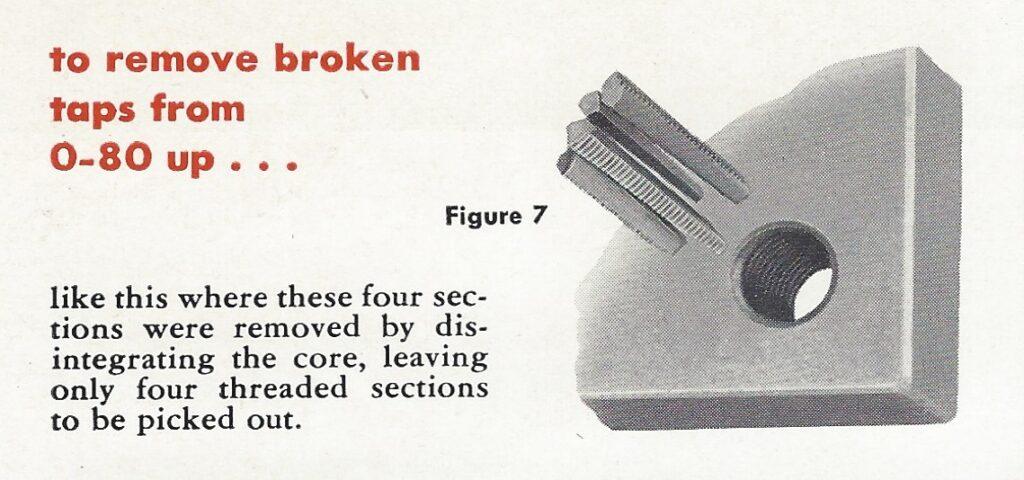
    Select an electrode that will only remove the center core of the tap. This will remove the core of the tap and leave the flutes standing in the threaded section. These may be blasted out with air or removed with a magnetic pick set. You will be left with a perfect threaded hole.

    5. When you are removing broken drills, snap off the flutes after every two inches of cutting travel. This may be done quite easily using the same size drill and rotating it in the hole.

    6. Removing Hardened Screws and Studs:
    You need to select an electrode approximately .020 under the minor diameter of the thread. For a clean cut, collapse the wall of the screw – remove the particles and retap. This will clean out the male threads without damage to the female threaded section. You may also choose to disintegrate a square or hex in the stud and turn it out with the proper size tool.
    Caution: Always make sure your electrode is straight

    7. Replace the coolant frequently – Clean the tank every 4-6 hours of operation. The metal disintegration process creates abrasive particles which can shorten the pump life.

    8. Please consult with Electro Arc if your machine is in need of repair.  If your machine is under warranty, do not attempt to make repairs prior to contacting our facility as it will void your warranty, additionally always consult with your operators manual for electrical diagrams, troubleshooting steps, and part numbers.

    Now You can Download our Troubleshooting Guide for Free!
  • 10 Ways you can use Electro Arc Metal Disintegrators

    When you think of a metal disintegrator you probably think of removing broken bolts.  Electro Arc metal disintegrators have a variety of uses.  Disintegrating hard metal is easy with our machines!  A minute arc causes the disintegration process at predetermined intervals.  These arcs burn microscopic pieces of your work metal.

    Here are just 10 ways you can use your Electro Arc metal disintegrator to save time and money by accomplishing in minutes what would have taken you hours or days to do in the past.

    https://youtu.be/2YEE1JfxPwo

    Broken Taps

    You can use your Electro Arc metal disintegrator to remove broken taps from any material. A machine with an Arc*er head will remove taps between #6 – 1 1/4″.  If you need to remove between #0 and 2″ or bigger, the IQ head is built to disintegrate the largest and smallest taps.  If you will be disintegrating carbide, look into our DC metal disintegrators!

    Broken Studs

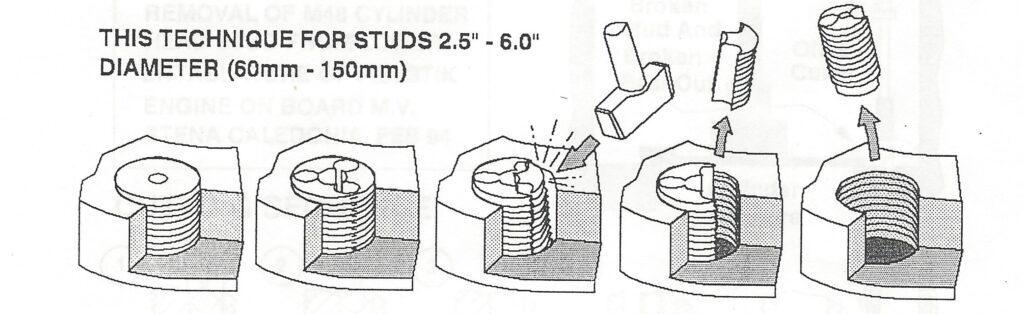
    You can remove broken studs  with an Electro Arc metal disintegrator.  Use one of our DC models to remove larger diameter studs (2.5″ – 6″) As illustrated below:


    Broken Drills

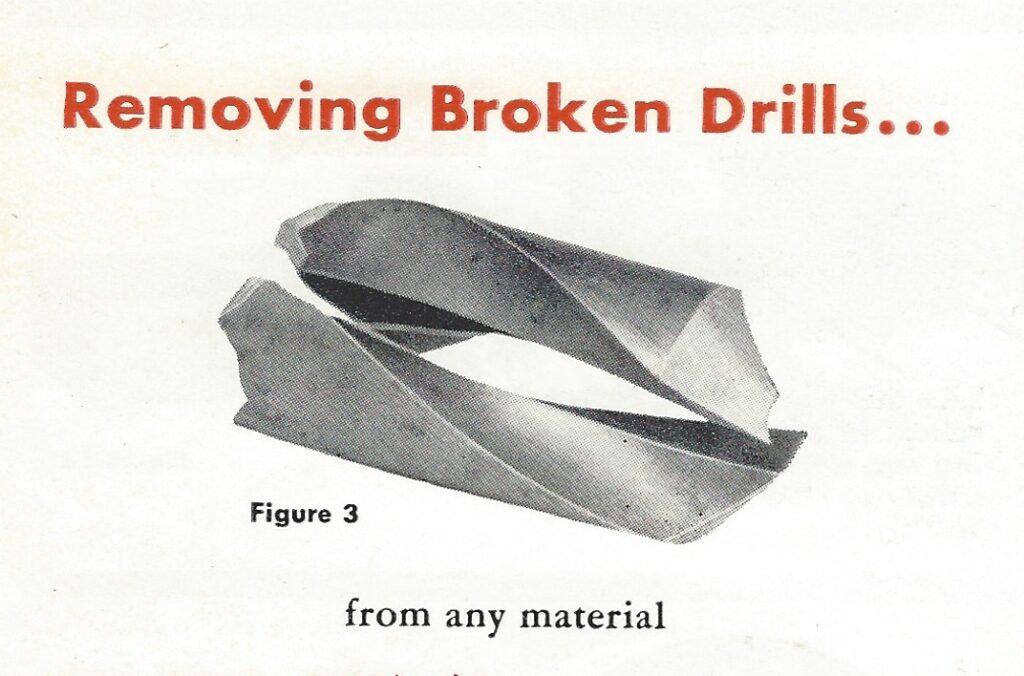
    Don’t waste hours removing broken drills.  Save money and salvage your parts.

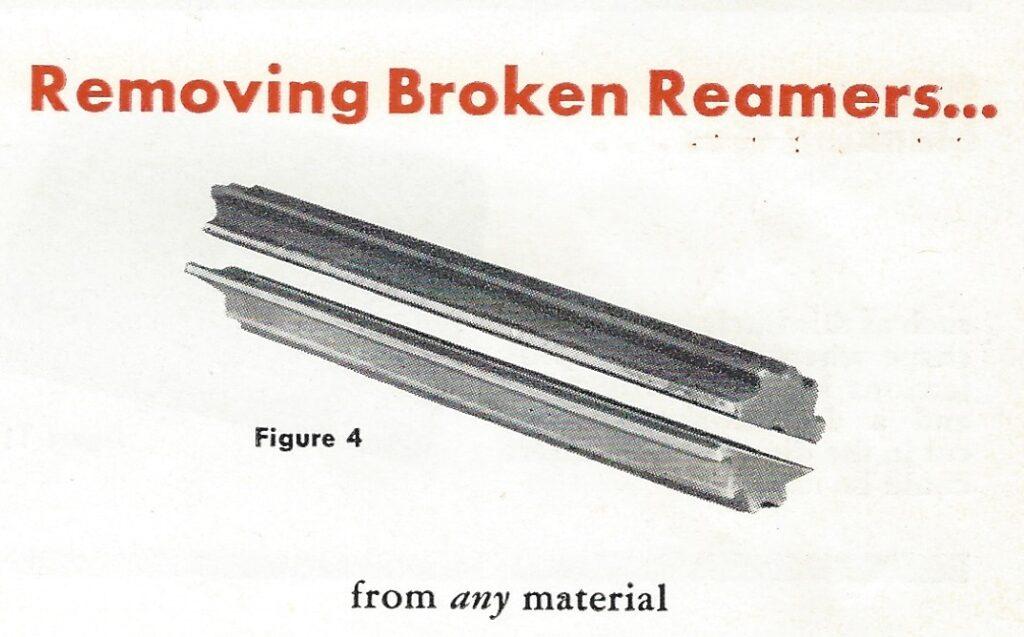
    Broken Reamers

    When reamers break they can be especially hard to remove.  Use your metal disintegrator to remove broken reamers with no damage to your part.

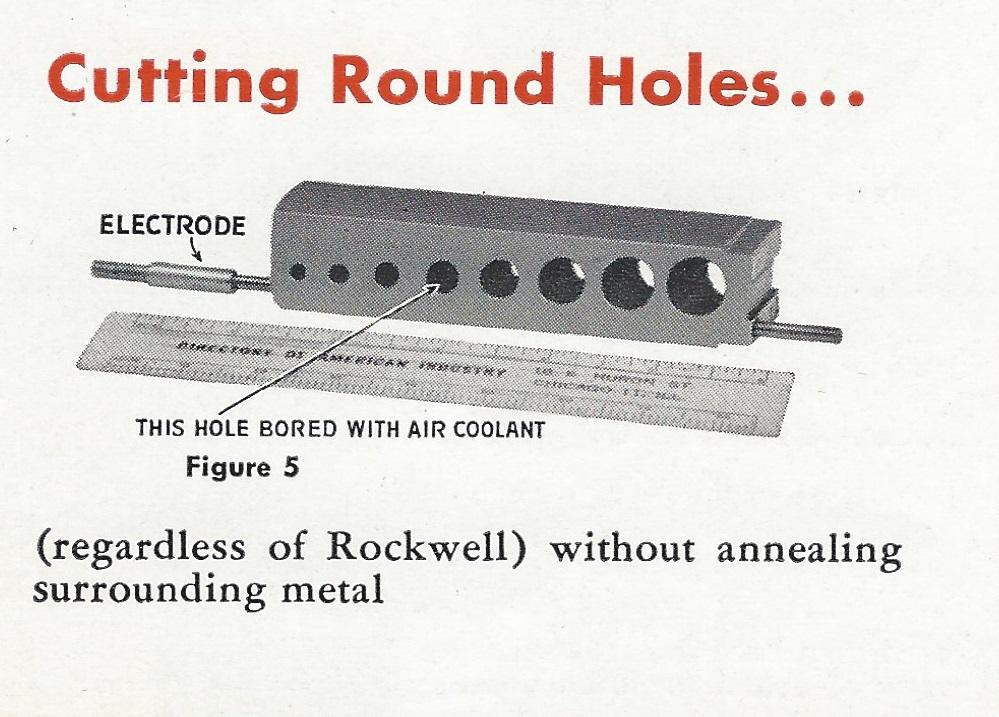
    Cut Round and Shaped Holes

    Your metal disintegrator can be used to cut round holes without annealing the surrounding metal regardless of the rockwell hardness!

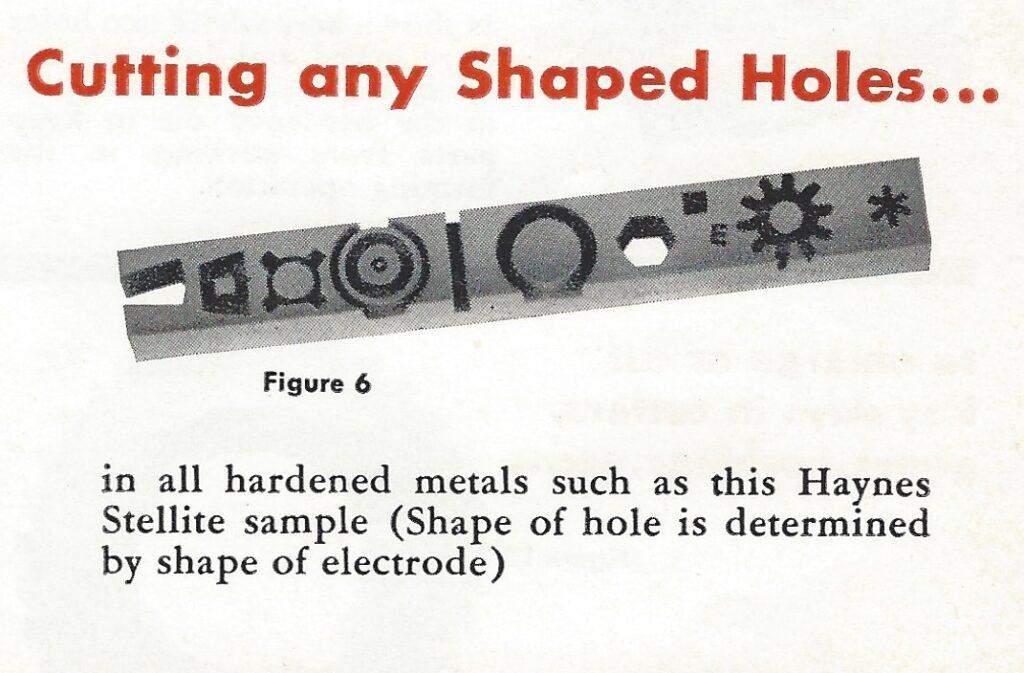
    Cut shaped holes in hardened metals using shaped electrodes.

    Preserve the thread when you remove large broken taps by disintegrating out the core.  Our magnetic pick set helps you remove the sections in no time!

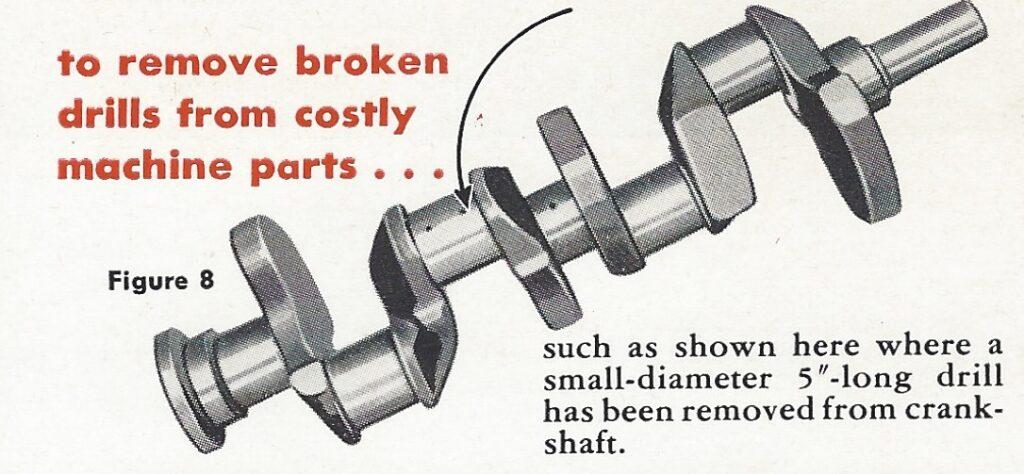
    You can remove small diameter drills from expensive parts saving you from salvaging expensive machine parts.

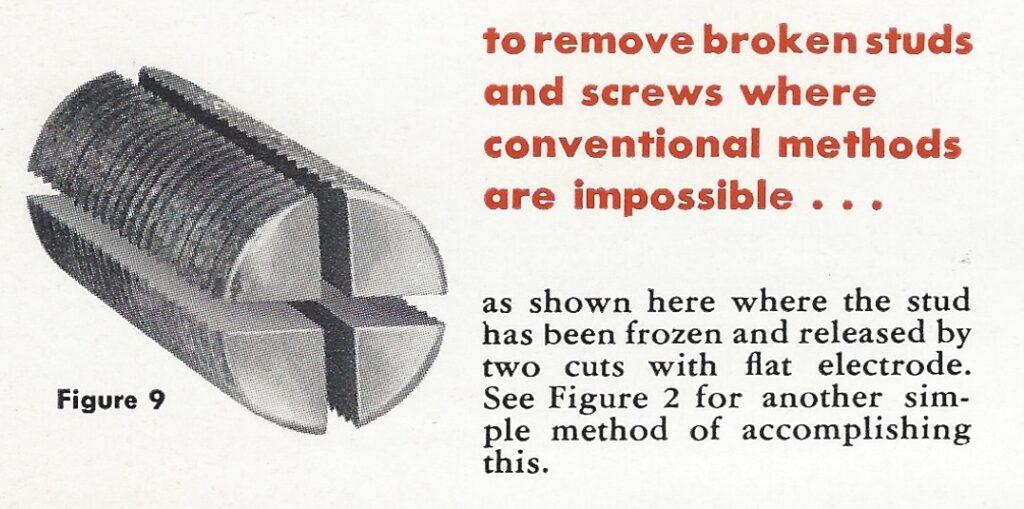
    When you have a frozen stud our metal disintegrators can still save you time and money by removing the broken stud, screw or bolt with two cuts.

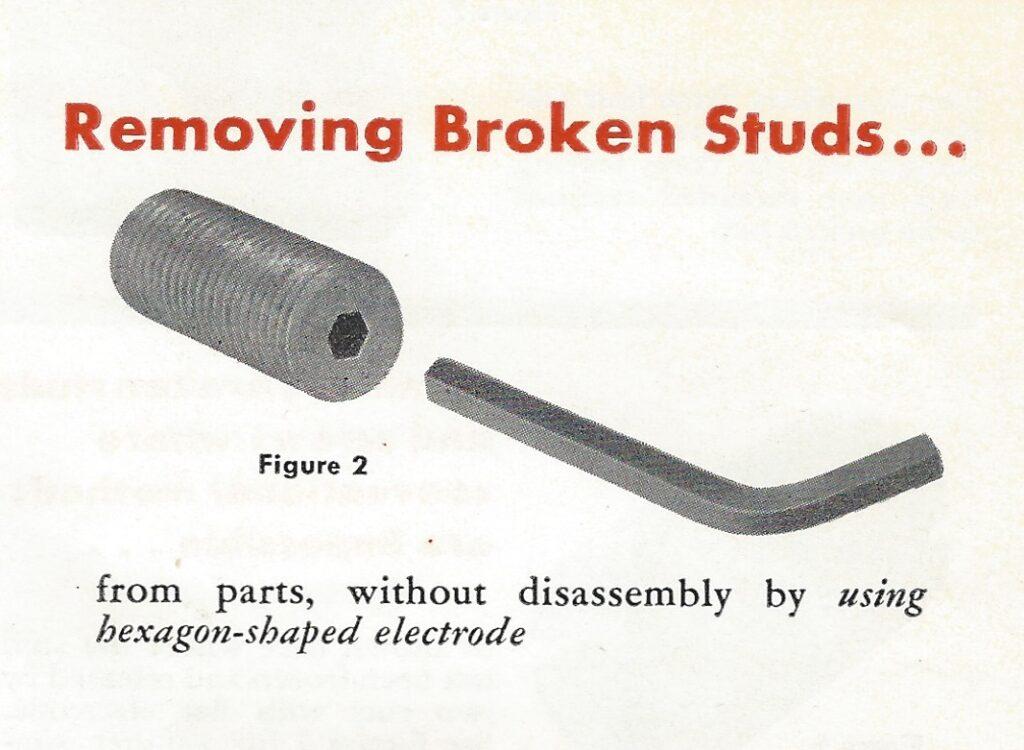
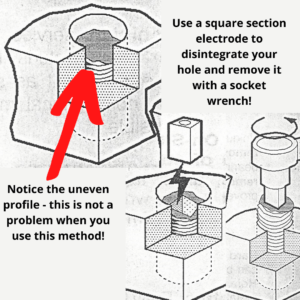
    You may have wiped out half of the thread on your broken bolt trying to remove it, broken easy-out in the hole, made a mess trying to weld out a broken stud, or totally galled the thread when you were trying to remove that broken stud.  If you really want an easy solution for removing broken studs and screws, we have your solution!  An alternative to the “two cuts” method illustrated above?  The square hole.  When you disintegrate a square hole in your broken studs you can use an socket wrench to remove them!


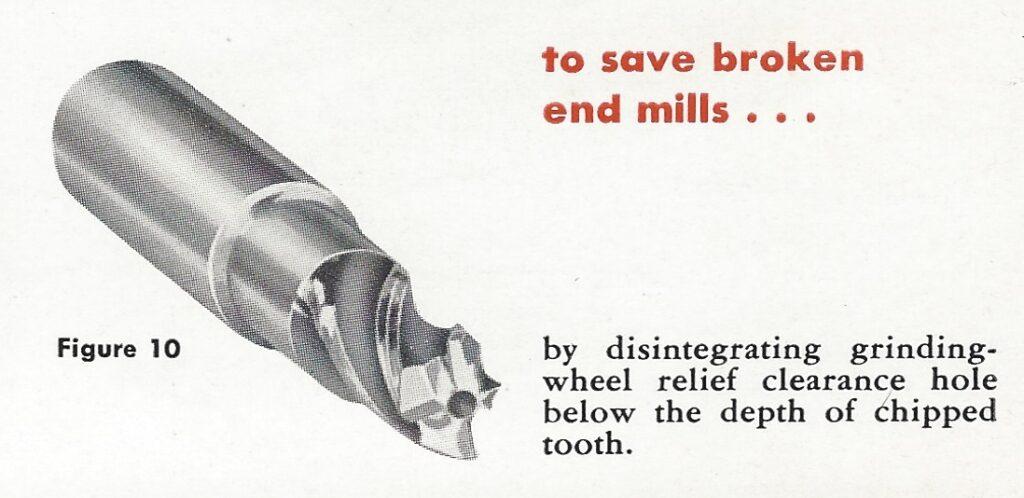
    Save your broken end mills!  As any machine shop knows, broken end mills can shut down operations costing your company more money per hour than you can afford!  Our Metal disintegrators will save your broken end mill and save you money immediately!

    An Electro Arc metal disintegrator is an investment some companies use to provide metal disintegration services for time sensitive jobs!  Most of our customers need the metal disintegrator to continue operations this is especially true for power stations, petro-chemical works, oil equipment, offshore installation ships and general process industries.  In these industries every minute is worth thousands of dollars.  If you have key piece of equipment, that needs repair due to a broken fastener you need it now!  Easy out will not cut it in these settings!

    Applications go well beyond just broken stud and bolt removal.  you can cut slots 1mm wide, and 10mm deep in heavy test pieces for calibration or deep cuts through seized clevis pins.  Orientation is never a problem with our versatile disintegrating heads!

    Are you looking for more applications for your metal disintegrator?  Check out our new post 10 More Ways you Can use Electro Arc Metal Disintegrators.

  • Electro Arc Metal Disintegrators made in Michigan since 1947

    Electro Arc is the original manufacturer of Metal Disintegrators based in Michigan.  The company’s founder, Harold Stark patented the AC metal disintegration process in 1942 and opened Electro Arc’s doors in 1947.  Stillion Industries purchased Electro Arc in 2019 and carries on the quality name that Electro Arc metal disintegrators have become synonymous with.

    Electro Arc Metal Disintegrators Last a Lifetime

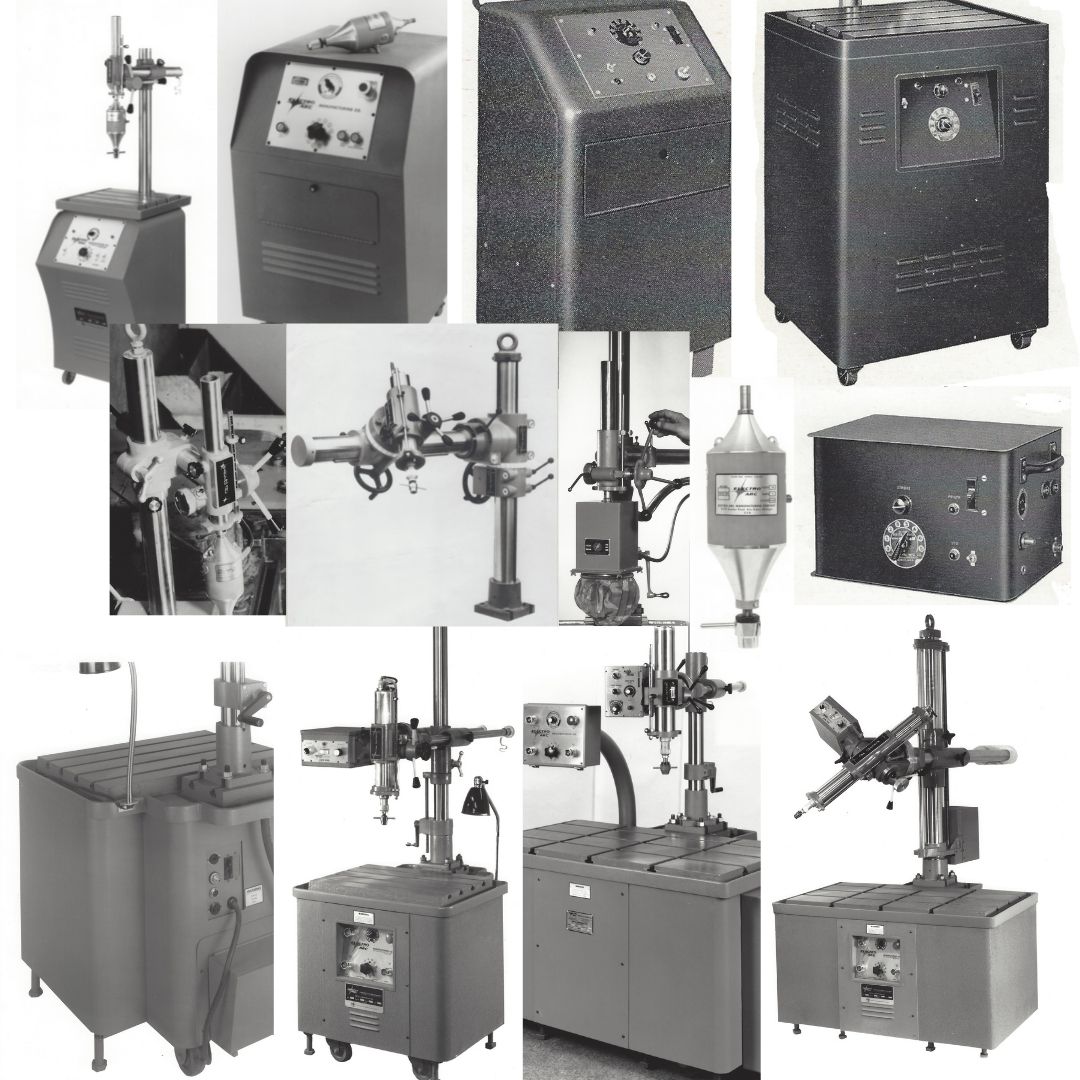
    You can see one of Electro Arc’s original paper promotions above, featuring the following models: 

    Model 2-S – Still one of our most popular portable models!  This basic metal disintegrator now features our Arc-er Head and portable design which make it perfect for use in small shops.

    1-S (See below) – The model 1-S was the largest table top metal disintegrator offered by Electro Arc initially.  

    2-SA – The model 2-SA was one of the first tabletop metal disintegrators offered by Electro Arc.  This self-contained unit is great for high production plants and tool shops.

    3-S – The model 3-S originally offered with no built-in coolant tank offers great portability for use in confined spaces.

    Not shown on this flyer, the Carbide Impregnator was another flagship product Electro Arc was known for between the 1940s and 1970s.  Electro Arc is the original and best manufacturer of metal disintegrators in the world.  Our machines are known for their durability and long-lasting design.  Now among over 40 configurations available, we are confident you will find an Electro Arc metal disintegrator is still the best value for your application!

    The location and contact information is NOT correct in this vintage promotion

    Over 75 Years of Michigan Manufacturing

    As you can see, the original disintegrating head is different than our current Arc-er, IQ, and Servo disintegrating heads.  The features of Electro Arc metal disintegrators are the same great features allowing anyone to use our machines.  Electro Arc Metal Disintegrators have castors, the choice of AC or DC, and portable or tabletop, including the option to order a custom table top size.  Most models allow you to choose your KVA power rating.  Additional features include support options, head options, remote start/stop, and more!

    In 2004, Electro Arc purchased Uni-Tek and integrated DC metal disintegrators into our product line.  Our most powerful machine, the Bolt Eater represents the heavy-duty application of metal disintegration with both portability and the power to remove large bolts!

    Stillion Industries is proud to carry on the Electro Arc Metal Disintegrator legacy in Dexter Michigan! We continue to improve the metal disintegrator design and offer repair and refurbishing services for old machines. Learn more about Electro Arc’s history.

    Electro Arc Portable AC Metal Disintegrators